









If you’re looking for the short answer, here it is: The fundamental difference between hard and soft magnetic materials lies in their “memory” of magnetism.
Hard magnetic materials (permanent magnets) are like a permanent marker; once you magnetize them, they stay magnetic for a long time. Soft magnetic materials are like a pencil and eraser; they magnetize easily when power is on but lose that magnetism almost immediately when the field is removed.
By choosing the right one, you ensure your product’s efficiency, reduce heat generation (especially in transformers), and significantly lower your bill of materials (BOM) costs.
1. The “Golden Rule” of Coercivity: 0.8kA/m
In my 15 years in the magnetics industry, I’ve seen many buyers get confused by technical datasheets. If you want to cut through the jargon, look at one number: Intrinsic Coercivity (Hcj).
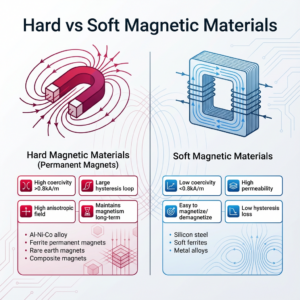
- Permanent (Hard) Magnets: Coercivity > 0.8 kA/m.
- Soft Magnets: Coercivity < 0.8 kA/m.
Think of coercivity as “stubbornness.” Hard magnets are incredibly stubborn—they resist demagnetization. Soft magnets are “easy-going”—they switch polarities back and forth thousands of times per second without much resistance.
Expert Insight: According to research published on ScienceDirect, the low coercivity in soft materials is what allows them to have high permeability, making them the “highways” for magnetic flux in electrical circuits.
2. Hard Magnetic Materials: The Powerhouses of Stability
Hard magnetic materials, often called permanent magnets, are the heart of motors, speakers, and sensors. Once we “charge” these materials in a massive magnetic field, they hold onto that energy.
Common Types I Work With Daily:
- Rare Earth Magnets (NdFeB & SmCo): The kings of strength. If you need a tiny magnet to lift a heavy load, Neodymium (NdFeB) is your go-to.
- Ferrite (Ceramic) Magnets: These are the most cost-effective. They aren’t super strong, but they resist corrosion like a champ.
- AlNiCo (Aluminum-Nickel-Cobalt): Old school but essential. They have incredible temperature stability.
- FeCrCo: These are unique because they are “machinable”—you can actually drill or turn them before the final heat treatment.
Why use Hard Magnets?
The “High Hysteresis Loop” area in hard magnets represents the energy stored. Because they have a large loop, they provide a constant magnetic field without needing a continuous power supply. This is why your Tesla motor doesn’t need an electromagnet for the rotor—the permanent magnets do the heavy lifting for free.
Best Practice: When sourcing NdFeB magnets for high-temperature environments (like automotive engines), don’t just look at the Grade (e.g., N35). Look at the H series or SH series. These are specifically engineered with higher coercivity to prevent permanent “dying” (demagnetization) at 120°C+.
3. Soft Magnetic Materials: The Masters of Transformation
If hard magnets are about “staying put,” soft magnets are about “flow.” These materials are designed to conduct, convert, and transmit electromagnetic energy.
The Main Players:
- Silicon Steel (Ferrosilicon Alloy): You’ll find these in almost every power transformer and large industrial motor. They are cheap and reliable for 50/60Hz applications.
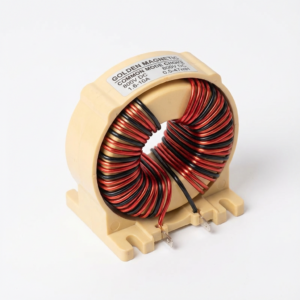
- Soft Ferrites (MnZn and NiZn): These are the stars of the electronics world. If you’re building a switching power supply or an EMI filter, you need these.
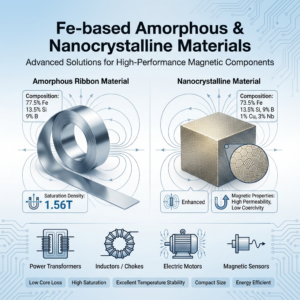
- Amorphous and Nanocrystalline: These are the “luxury” soft magnets. They have incredibly low core loss, perfect for high-efficiency EV chargers.
The Mechanism: Easy In, Easy Out
Soft magnets have high permeability. This means magnetic field lines prefer traveling through the metal rather than through the air. In a transformer, the soft magnetic core “grabs” the magnetic field from the primary coil and delivers it to the secondary coil with minimal loss.
4. Hard vs. Soft: A Side-by-Side Comparison
I’ve put together this table based on standard industry metrics (referenced from Magnet Academy) to help you visualize the trade-offs.
| Feature | Hard Magnets (Permanent) | Soft Magnets |
|---|---|---|
| Coercivity ($H_c$) | Very High (> 0.8 kA/m) | Very Low (< 0.8 kA/m) |
| Hysteresis Loop | Wide and fat (Large area) | Narrow and thin (Small area) |
| Energy Loss | High per cycle (but usually static) | Very Low (to prevent heating) |
| Ease of Demagnetization | Very Difficult | Very Easy |
| Primary Function | Providing a constant field | Channeling/Converting energy |
| Common Application | BLDC Motors, MRI, Speakers | Transformers, Inductors, Relays |
5. Experience Sharing: How to Choose for Your Project
In my years of consulting for hardware startups, I see the same mistake: people over-specifying their magnetic needs. Here is my “Best Practice” framework:
Rule 1: Frequency is King
If your application involves alternating current (AC), you are in the world of Soft Magnets. If you are using 50Hz (Grid power), go with Silicon Steel. If you are using 100kHz (Modern electronics), you must use Soft Ferrites. Why? Because at high frequencies, steel gets so hot it can melt due to “eddy currents.”
Rule 2: Stability vs. Strength
If you need a permanent magnet for an outdoor sensor, don’t use Neodymium unless it’s heavily coated. It rusts. Ferrite is better there. If you need maximum torque in a small robot arm, Neodymium is your only choice.
Rule 3: The “Air Gap” Factor
When designing with soft magnets (like a flyback transformer), the “air gap” is your secret weapon to prevent saturation. Even though the material is “soft,” it can get “full” of magnetism and stop working. Adding a tiny 0.1mm gap can actually make your circuit more stable.
Pro Tip: Always ask your supplier for a B-H Curve report. It’s the “fingerprint” of the batch. If they can’t provide it, they probably don’t have good quality control. You can read more about interpreting these curves on the IEEE Magnetics Society website.
6. Real-World Application Scenarios
Case A: The Electric Vehicle (EV)
An EV uses both. The Traction Motor uses high-coercivity Neodymium magnets (Hard) to turn the wheels. Meanwhile, the On-board Charger uses Nanocrystalline cores (Soft) to convert the AC from the wall into DC for the battery. If you swapped them, the car wouldn’t move, and the charger would explode.
Case B: The Simple Door Latch
For a kitchen cabinet latch, we use Ferrite (Hard). It’s cheap, it’s permanent, and it doesn’t need to be strong. We don’t use soft magnets here because as soon as you let go, the door would fall open!
7. Trends in 2024: What’s Changing?
The biggest trend I’m seeing is the push for Cobalt-free and Heavy Rare Earth-free magnets. Due to supply chain volatility (source: US Department of Energy – Critical Materials Assessment), there is a massive shift toward “Grain Boundary Diffusion” (GBD) technology. This allows us to make hard magnets that are incredibly heat resistant without using as much expensive Dysprosium.
If you are an engineer, you should be asking your suppliers: “Are you using GBD technology to reduce my cost on high-temp magnets?”
8. Frequently Asked Questions (FAQ)
Q1: Can a soft magnet become a hard magnet?
No. It’s about the internal grain structure and chemistry. While you can “accidentally” magnetize a piece of steel (soft magnet) slightly, it will never have the coercivity required to be a “hard” magnet. It’s like trying to turn a piece of rubber into a diamond; they are just built differently.
Q2: Why does my soft magnetic core get hot?
This is usually due to Core Loss. It’s a combination of Hysteresis loss (the friction of switching magnetic domains) and Eddy Current loss. To fix this, use a material with higher resistivity (like moving from Silicon Steel to Ferrite) or use thinner laminations.
Q3: How do I measure the “strength” of these materials?
For hard magnets, we measure Residual Flux Density (Br) in Gauss or Tesla. For soft magnets, we focus on Initial Permeability ($\mu_i$). If you are buying, ask for the “Magnetic Properties Sheet.”
Q4: Is “Hard Magnetic” the same as “Hard Metal”?
No. “Hard” in magnetics refers to the magnetic properties (coercivity), not the physical hardness. However, many hard magnets (like Ferrites and NdFeB) are physically brittle and can chip easily.
Q5: What is the lifespan of a permanent magnet?
In theory, a high-quality Neodymium magnet loses about 1% of its strength every 100 years if kept within its temperature limits. However, if you overheat it once past its Curie Temperature, it can lose all its magnetism instantly.