









If you’re looking for the short answer to which material you should choose for your next transformer or inductor design, here it is: Use Fe-based Amorphous ribbon (1K101) if you are replacing traditional silicon steel to boost efficiency in low-to-medium frequency applications. Switch to Fe-based Nanocrystalline if you need high-frequency performance that rivals expensive cobalt-based alloys or bulky ferrites.
The immediate benefits of making this switch include a massive reduction in core losses (up to 70-80% compared to silicon steel), significantly smaller component footprints, and much better thermal stability. In an era where energy efficiency standards like IEC 60038 are getting stricter, these materials aren’t just “nice to have”—they are your competitive edge.
1. My First Encounter with the “Efficiency Wall”
In my 15 years of designing power electronics, I remember the exact moment I realized Silicon Steel had reached its limit. We were designing a high-power distribution transformer, and no matter how much we optimized the copper windings, the “no-load” losses were killing our efficiency ratings.
Then we discovered Fe-based Amorphous ribbons. By swapping the core, we saw the excitation current drop and the heat dissipate almost instantly. Since then, I’ve advocated for these “advanced metals” as the future of the industry. Let’s dive into why these materials—Amorphous and Nanocrystalline—are changing the game for B2B manufacturers and engineers alike.
2. Deep Dive: Fe-based Amorphous Ribbon (Grade 1K101)
Commonly known in the industry as the “Silicon Steel Killer,” Fe-based Amorphous ribbon (specifically the 1K101 grade) is a masterpiece of material science.
The Composition: Why it’s “Amorphous”
Standard steel has a crystalline structure—think of it like neatly stacked bricks. Amorphous metal is cooled so fast (at a rate of about one million degrees per second) that the atoms don’t have time to arrange themselves. They stay “disorganized,” like a liquid frozen in time.
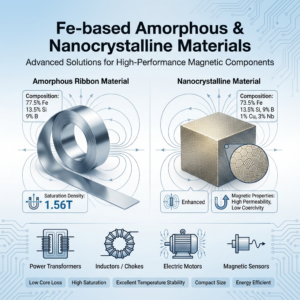
- Main Ingredients: Iron (77.5%), Silicon (13.5%), and Boron (9%).
- The Result: Because there are no “grain boundaries” for magnetic flux to bump into, the resistance to magnetization is incredibly low.
Key Technical Specs
- Saturation Flux Density (Bs): Hits a massive 1.56T.
- Performance: Significantly better than traditional silicon steel (which usually sits around 1.1T to 1.5T but with much higher losses).
- Competitive Pricing: It offers premium performance without the “luxury” price tag of specialized alloys.
Expert Insight: According to research published on ScienceDirect, the lack of crystalline anisotropy in amorphous ribbons is exactly what allows for such high permeability and low coercive force.
Best Applications for 1K101
If you are working in these fields, 1K101 is your best friend:
- Distribution Transformers: Especially those that need to meet high-efficiency “Green” standards.
- Medium-Frequency Transformers: Perfect for the 400Hz to 10kHz range.
- PFC (Power Factor Correction) Inductors: Where you need high-power anti-saturation capabilities.
- Current Transformers: For accurate AC measurement in industrial grids.
3. The “Super Material”: Fe-based Nanocrystalline
If Amorphous is the “workhorse,” Nanocrystalline is the “thoroughbred.”
The “Secret” Ingredients
Fe-based Nanocrystalline starts as an amorphous ribbon but undergoes a specialized heat treatment to grow tiny crystals (nanometers in size).
- Composition: Iron (73.5%), Silicon (13.5%), Boron (9%), plus the “magic” additions of Copper (1%) and Niobium (3%).
- Why Copper and Niobium? These elements act as nucleating agents, ensuring the crystals stay incredibly small and uniform.
Why it’s the “Future of Permalloy and Ferrite”
For years, engineers used Permalloy (Nickel-Iron) for high precision or Ferrite for high frequency. Nanocrystalline beats them both:
- Vs. Ferrite: Nanocrystalline has a saturation flux density ($B_s$) of 1.25T, compared to Ferrite’s measly 0.4T to 0.5T. This means you can make your component 1/3 the size while handling the same power.
- Vs. Cobalt-based Alloys: It offers nearly the same magnetic performance but at a fraction of the cost.
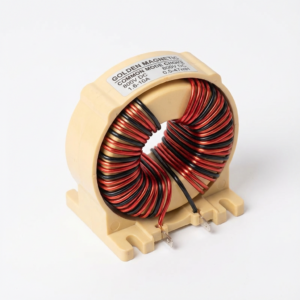
Best Practice: When designing Common Mode Chokes (CMCs) for EMI filtering, use Nanocrystalline. Its high permeability allows you to achieve the necessary inductance with fewer copper turns, which reduces the “Parasitic Capacitance” and improves high-frequency noise suppression.
4. Side-by-Side: Amorphous vs. Nanocrystalline vs. Silicon Steel
I’ve put together this comparison table based on standard industrial datasheets and IEEE Magnetics Society data.
| Property | Silicon Steel (CRGO) | Fe-based Amorphous (1K101) | Fe-based Nanocrystalline |
|---|---|---|---|
| Saturation ($B_s$) | 1.9T – 2.0T | 1.56T | 1.25T |
| Core Loss (at 50Hz) | High (1.0 W/kg) | Very Low (0.2 W/kg) | Extremely Low |
| Permeability ($\mu_i$) | ~1,000 | ~10,000 | > 80,000 |
| Frequency Range | < 1 kHz | 50Hz – 20kHz | 10Hz – 100kHz+ |
| Coercive Force ($H_c$) | ~30 A/m | < 4 A/m | < 1 A/m |
| Best For… | Heavy industrial motors | Distributing transformers | EMI Chokes, Hi-Freq Power |
5. Pro-Tips for Designers and Procurement
Over the years, I’ve seen many companies fail to transition to these materials because they treat them like regular steel. Here is the Best Practice list you need to follow:
Tip 1: Watch the Stress
Both amorphous and nanocrystalline ribbons are stress-sensitive. If you drop the core or apply too much pressure during winding, the permeability will drop. Always use a protective plastic casing or a soft epoxy coating to maintain performance.
Tip 2: Temperature Stability is your Ally
One thing I love about Nanocrystalline is its high Curie Temperature (approx. 570°C). Unlike Ferrites, which can lose their magnetic properties if they get too hot (Curie point ~200°C), Nanocrystalline stays stable in harsh industrial environments.
Tip 3: The “Total Cost of Ownership” (TCO) Argument
If you are in procurement, don’t just look at the price per kg. Look at the energy savings. An Amorphous-core distribution transformer pays for itself in energy savings within 3-5 years. According to ResearchGate studies on Amorphous Transformers, the reduction in “no-load” loss is a massive selling point for utility companies.
6. Real-World Application Scenarios
Scenario A: The EV Charging Station
In a high-power EV fast charger, space is at a premium. Using a Nanocrystalline Saturated Reactor or a Spike Killer allows you to handle massive current surges without the component overheating. It’s the difference between a charging station that’s the size of a fridge and one the size of a suitcase.
Scenario B: Solar Inverters
Solar power relies on PFC Inductors and Reactors. Fe-based Amorphous cores are perfect here because they handle the “ripple current” of DC-to-AC conversion with much lower heat generation than silicon steel, ensuring your solar system actually puts more power into the grid and less into wasted heat.
7. Frequently Asked Questions (FAQ)
Q1: Is Amorphous metal fragile?
Yes and No. In its raw ribbon form (usually 25-30 microns thick), it is very thin and can be brittle after annealing. However, once it is wound into a core and encased in a protective box or impregnated with resin, it is extremely durable for industrial use.
Q2: Why is Nanocrystalline more expensive than Amorphous?
The manufacturing process for Nanocrystalline is more complex. It requires the addition of Niobium and Copper, and a much more precise “secondary crystallization” heat treatment. You pay for the significantly higher permeability and frequency range.
Q3: Can I directly replace my Silicon Steel core with an Amorphous core?
Not always “drop-in.” Because Amorphous has a lower saturation (1.56T) than Silicon Steel (1.9T), you might need a slightly larger core volume. However, the reduction in losses usually makes the trade-off worth it.
Q4: How does Nanocrystalline act as a “Spike Killer”?
Because of its “Square” B-H loop characteristics, Nanocrystalline can be designed to absorb high-voltage transients (spikes) in a circuit, acting like a magnetic buffer that protects sensitive semiconductors.
Q5: Are these materials RoHS compliant?
Absolutely. All 1K101 and Fe-based Nanocrystalline materials are made primarily of Iron, Silicon, and Boron, making them environmentally friendly and compliant with global standards like RoHS and REACH.
8. Final Recommendation: Which one should you buy?
- Choose Fe-based Amorphous (1K101) if you are building Distribution Transformers, Large Industrial Inductors, or Power Transformers operating at grid frequencies. It is the best balance of cost and efficiency.
- Choose Fe-based Nanocrystalline if you are designing Switch-mode Power Supplies (SMPS), Common Mode Chokes, LAN Transformers, or Precision Sensors. Its performance at high frequencies is unmatched.