









If you’re looking for the short answer: Common mode inductance (or a common mode choke) is your project’s ultimate defense against electromagnetic interference (EMI). By using these components, you ensure that high-frequency noise is “choked” out while your power current passes through cleanly.
The immediate benefit? You pass EMC certification on your first try, your signals remain crystal clear, and your power supply doesn’t interfere with other electronics nearby. In the world of high-speed electronics and frequency converters, this isn’t just an “add-on”—it’s a necessity for reliability.
1. My Journey with EMI: Why Common Mode Chokes Matter
In my years as a board designer, I’ve seen countless projects hit a brick wall during the final testing phase. The culprit is almost always the same: EMI radiation. You’ve built a high-speed signal line or a switching power supply, and suddenly, it’s acting like a radio antenna, broadcasting noise that ruins everything.
That’s where the common mode inductor (often called a common mode choke) comes in. It is an electromagnetic component designed to suppress noise that is common to two or more lines. Unlike a standard inductor, it specifically targets signals traveling in the same direction on both lines—the “common mode” signals—while letting the “differential mode” signals (the ones you actually want) pass through.
The “Secret Sauce” of Board Design
When we design boards for computers or industrial frequency converters, we use these chokes to suppress electromagnetic waves generated by high-speed signal lines. Without them, your computer would likely reboot itself constantly, and your power supply would be a noisy mess.
Best Practice: When placing a common mode choke on your PCB, keep it as close to the entry point of the power source or the connector as possible. This “bottleneck” approach prevents noise from ever entering the rest of your circuit traces.
2. Breaking Down the Specs: The New Standard in Circular Core Inductors
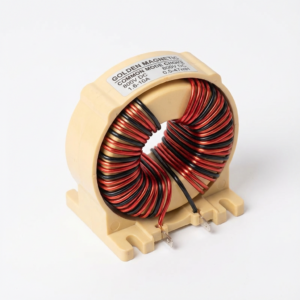
I’ve recently been reviewing the new series of circular core common mode inductors from Golden Magnetic, and they solve a problem that has plagued us for a long time: thermal performance at high voltages.
High Voltage Capacity (800V DC)
Most standard chokes struggle once you move into the industrial range. However, these new components are rated for up to 800 V DC or 250 V AC. This makes them perfect for DC link filtering in frequency converters.
| Feature | Golden Magnetic Series Specification |
|---|---|
| Rated Voltage | Up to 800 V DC / 250 V AC |
| Inductance Range | 0.5 mH to 47 mH |
| Rated Current | 1.6 A to 10 A |
| Size | 18.5mm x 31.3mm x 33.2mm |
| Stray Inductance | ~0.5% of rated value |
| Standards | RoHS, UL 94 V-0, IEC 60335-1 |
According to technical standards from IEEE Xplore, maintaining high inductance values at elevated voltages is critical for preventing core saturation, which can lead to a total failure of the EMI filtering capabilities.
3. Thermal Performance: Why “+70°C No Derating” is a Game Changer
In industrial environments, heat is the enemy. Traditionally, if your ambient temperature rises, you have to “derate” your component—meaning a 10A inductor might only be able to handle 5A because it can’t dissipate the heat.
The new series of circular core chokes has been engineered with excellent thermal performance. They can work at rated current in ambient temperatures up to +70°C without any derating.
Why does this happen?
The “circular core” (toroidal) design is naturally more efficient at heat dissipation than some E-core or block designs. Because the winding is distributed evenly around the ring, there are fewer “hot spots.” This allows the choke to maintain a large inductance value even when the current is high and the environment is hot.
Best Practice: If your device is going into a sealed enclosure with no active cooling (fans), always choose an inductor with a “No Derating” temperature spec higher than 60°C. It’s the cheapest insurance policy you can buy against field failures.
4. Safety and Environmental Resilience: UL 94 V-0 and Potting
If you are exporting products to Europe or North America, you know that safety certifications are non-negotiable. One of the standout features of this new common mode inductor is its material construction:
- Flame Retardant: The housing uses plastic complying with UL 94 V-0. In simple terms, if there is a spark, the plastic won’t sustain a flame.
- Fully Potted: The windings are completely encased in a potting compound.
- Certification: It meets IEC 60335-1 Chapter 30 (which includes the rigorous hot wire and ball pressure tests).
Dealing with Pollution
I’ve worked on projects for textile factories and chemical plants where the air is filled with conductive dust or high humidity. Standard “open” inductors fail quickly in these environments due to arcing or corrosion. Because these new chokes are completely potted, they are protected from “high pollution” environments. They are essentially air-tight.
Expert Insight: According to IEC (International Electrotechnical Commission), potting components significantly increases their dielectric strength, allowing for a more compact design without risking a high-voltage jump between windings.
5. Symmetrical Interference and Stray Inductance
A common question I get from junior engineers is: “What about symmetrical (differential) interference?”
While a common mode choke is designed for common mode noise, it’s not a “one-trick pony.” The stray inductance in these power line chokes is roughly 0.5% of the rated value. This small amount of stray inductance actually helps provide additional attenuation for symmetrical interference. It’s like getting a small differential mode filter for free inside your common mode component.
6. Key Applications: Where Should You Use These?
Based on the technical profile of these 800V-rated circular core inductors, there are two “sweet spot” applications:
A. Frequency Converters
In a frequency converter, the DC link is the heart of the system. It’s where AC is converted to DC before being pulsed back out to a motor. This process generates massive amounts of high-frequency noise. These chokes are specifically developed for DC link filtering, ensuring the converter doesn’t burn out or interfere with the factory’s control systems.
B. High-End Power Supplies (PSUs)
For medical-grade or industrial power supplies where reliability is the #1 priority, the ability to handle up to 10A with a compact 18.5mm footprint is incredible. Because the size is standardized (18.5mm x 31.3mm x 33.2mm), it can often be “dropped in” as an upgrade to existing designs without needing a new PCB layout.
7. Professional Experience: The “Golden Magnetic” Advantage
When I look at the Golden Magnetic circular core common mode inductor, I see a product designed for the reality of modern manufacturing. It’s RoHS compliant, which is a baseline for global trade, but it goes further by solving the “size vs. power” dilemma.
Usually, to get 47mH of inductance at high current, you’d need a component the size of a coffee mug. By optimizing the circular core and using high-quality winding techniques, they’ve kept it down to a package that fits easily into a standard server rack or a small motor controller box.
8. Frequently Asked Questions (FAQ)
Q1: Can I use a common mode choke for DC circuits?
Yes! In fact, they are essential for DC-DC converters. As the reference article mentions, these are rated up to 800V DC and are specifically used for DC link filtering to suppress high-speed switching noise.
Q2: What is the benefit of a “Circular Core” over other shapes?
The circular (toroidal) shape has a closed magnetic path, which means it has very low electromagnetic leakage. This makes it much more efficient and reduces the chance that the inductor itself will interfere with nearby components on your board.
Q3: What happens if I exceed the 10A rated current?
If you exceed the rated current, the core may enter “saturation.” When this happens, the inductance drops sharply, and the component stops filtering noise. Additionally, it will start to generate excessive heat, which could damage the insulation. Always stay within the 1.6A to 10A range specified for the specific model.
Q4: Is the potting really necessary?
If you are working in a clean, temperature-controlled office environment, maybe not. But if your product is going into an industrial cabinet, a kitchen appliance (covered by IEC 60335), or any place with dust and moisture, potting is a must. It prevents short circuits caused by “creepage” across polluted surfaces.
Q5: How do I choose between 0.5 mH and 47 mH?
This depends on the frequency of the noise you are trying to block. Generally, higher inductance (47 mH) is better for blocking lower-frequency noise, while lower inductance (0.5 mH) is used for very high-frequency interference. Most engineers use an EMI receiver to test which value provides the best “quietness” for their specific circuit.