









New Energy Vehicles
Only in the past few years have iron-based nanocrystalline materials become increasingly accepted in modern electronic design. Nanocrystalline materials have a proven track record of high performance and improved reliability during manufacturing, and this material is now available from multiple sources. Nanocrystalline soft magnetic materials now outperform permalloy, ferrites, and even amorphous cobalt-based alloys in a growing number of applications.
Nanocrystalline magnetic cores need to have high permeability, high saturation, and low power consumption. They do not affect asymmetrical power currents but can effectively suppress asymmetrical EMI noise currents when used as common-mode chokes.
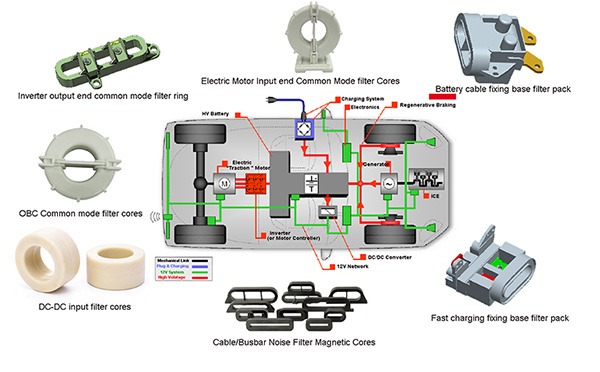
We have developed a series of magnetic cores for these applications to meet the requirements of different power levels and operating conditions. At the same time, we have designed a convenient and reliable mounting method to meet various application requirements.
Widely used in electric or hybrid vehicles as common-mode noise filters for on-board chargers, on-board DC-DC converters, DC/AC output terminals of motor drivers, and on-board air conditioners.
Features:
- Compliant with AEC-Q200 automotive standards and IATF16949 quality system certified
- Features a clean room meeting cleanliness requirements; compliant with IP67 standards
- Maximum continuous operating temperature: up to +130°C or up to +155°C
- Excellent temperature stability
- Can be flexibly customized according to customer application requirements
Features:
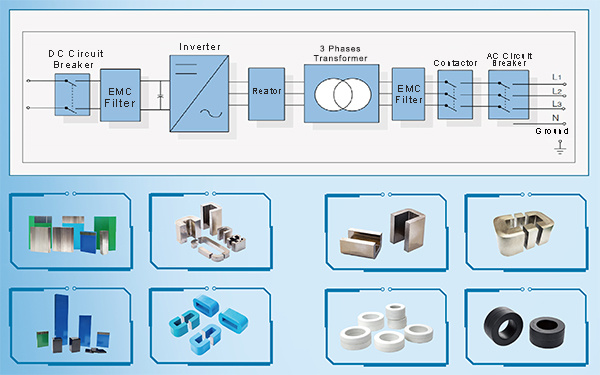
- Low loss, reduced temperature rise
- High saturation magnetic induction, reduced size
- Excellent temperature stability
- Easy to assemble
- Open gap, beneficial for resistance to DC bias saturation
- Custom shapes for more applications
- Special anti-rust treatment
- Block shape, suitable for assembly with other materials
Photovoltaics & Energy Storage
The main applications of amorphous and nanocrystalline materials in the future will be in photovoltaics and energy storage, including photovoltaic, wind energy, grid-connected, and off-grid systems. Solar energy has been widely deployed as a key form of renewable and sustainable electricity to mitigate climate change. Besides the demands on power conversion system efficiency, selecting magnetic components for photovoltaic solutions can be challenging for design engineers.
In these new application areas, amorphous and nanocrystalline materials are primarily used to manufacture magnetic cores for communication modes, specifically for high-frequency power conversion in photovoltaic inverters. Grid-connected solar inverters are the core power regulators in photovoltaic systems, enabling the integration of photovoltaic power into the grid and loads.
The main applications of amorphous and nanocrystalline materials in the future will be in photovoltaics and energy storage, including photovoltaic, wind energy, grid-connected, and off-grid systems. Solar energy has been widely deployed as a key form of renewable and sustainable electricity to mitigate climate change. Besides the demands on power conversion system efficiency, selecting magnetic components for photovoltaic solutions can be challenging for design engineers.
The main electromagnetic components in the structure of a grid-connected solar inverter are the output filter inductor, common-mode inductor, and isolation transformer. The main function of the output filter inductor is to convert the PWM modulated waveform into a sine wave with minimal distortion, thereby feeding a clean sine wave into the grid or load.
Furthermore, with the full deployment of smart grids, smart meters will gradually replace traditional mechanical meters. Precision current transformers are key components of smart meters, and with the construction of smart grids, amorphous and nanocrystalline alloy materials will also face new growth opportunities.

Consumer electronics
Consumer electronics has always been the largest market for magnetic materials in China, but the consumer electronics landscape has undergone a qualitative transformation. Flat-panel TVs have replaced traditional CRT TVs, and the trend towards digitalization has become mainstream.
Because the electromagnetic waves generated can interfere with various electrical appliances and cause environmental electromagnetic pollution, green and environmentally friendly practices have been prioritized both domestically and internationally. The sale of electrical appliances that do not have electromagnetic compatibility and resistance to electromagnetic interference is prohibited, thus creating a significant demand for anti-electromagnetic interference cores.
In televisions, each LCD TV backlight inverter requires 12-26 pairs of ferrite cores, making this undoubtedly the most important new growth point for the soft magnetic ferrite industry in the near future.
Rail Transport
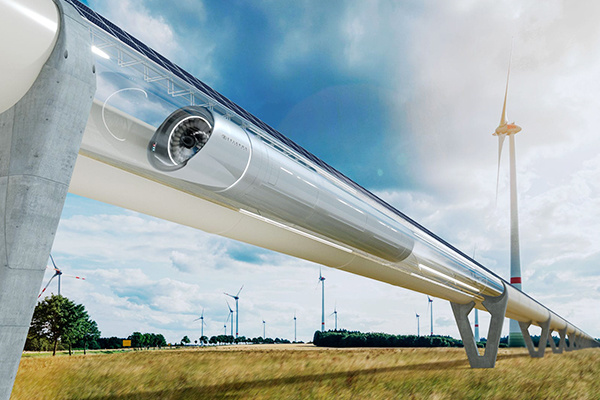
Maglev trains are a modern, high-tech rail transportation system that uses electromagnetic force to achieve non-contact suspension and guidance between the train and the track, and then utilizes electromagnetic force generated by linear motors to propel the train, thus reducing friction.
In 1922, German engineer Hermann Kemper proposed the principle of electromagnetic levitation and subsequently applied for a patent. Since the 1970s, with the continuous strengthening of the economic power of industrialized countries, and in order to improve transportation capacity and meet the needs of economic development and people’s livelihoods, countries such as Germany, Japan, and the United States have successively carried out research and development of maglev transportation systems.
Military
Nanocrystalline magnetic cores are used in various military applications due to their ability to store and manipulate electronic signals. Because of their ability to store and manipulate electronic signals, they are essential components in many military applications.
They help improve the accuracy, range, and security of various military systems.
- Radar Systems: Magnetic cores are used in the construction of radar systems, which are used by the military for surveillance and detection purposes.
The magnetic cores are used to store and process the signals generated by the radar system, which helps improve its accuracy and range. - Electronic Warfare: Magnetic cores are also used in electronic warfare applications, including jamming and countermeasures.
They are used to store and manipulate signals generated to interfere with enemy communications or other electronic systems. - Communication Systems: Magnetic cores are used in military communication systems to store and process signals. They are also used in encryption and decryption systems, helping to ensure secure communication between military personnel.
- Missile Guidance Systems: Magnetic cores are used in the construction of missile guidance systems, which the military uses to guide missiles to their targets. The magnetic cores are used to store and process the signals generated by the missile guidance system, which helps ensure accuracy and precision.

New Energy Vehicles
- Power Types: Pure electric vehicles, 48V mild hybrid electric vehicles, plug-in hybrid electric vehicles, fuel cell electric vehicles
- Functional Modules: On-board charger (OBC), DC-DC converter, battery management system (BMS), thermal management system, smart cockpit, power factor correction
- Power Levels: On-board charger (3.3–22kW); DC-DC converter: 12V/48V/400V/800V (voltage platform)
- Power Inductors: PFC inductor, parallel inductor, resonant inductor, output filter inductor, DAB symmetrical inductor, bidirectional CLLC inductor
- Related Core Materials: NPA/NPX/GPV/NPV/NPI

Charging Station
- Application Scenarios: DC charging stations; charging station modules
- Power Levels: DC charging stations: 30-720kW (single gun); Charging modules: 7-60kW (single module)
- Power Inductors: PFC inductors, Buck/LLC resonant inductors, output filter inductors, DAB symmetrical inductors, coupled inductors, common mode inductors
- Related Core/Materials: NPV/NPC/NPX
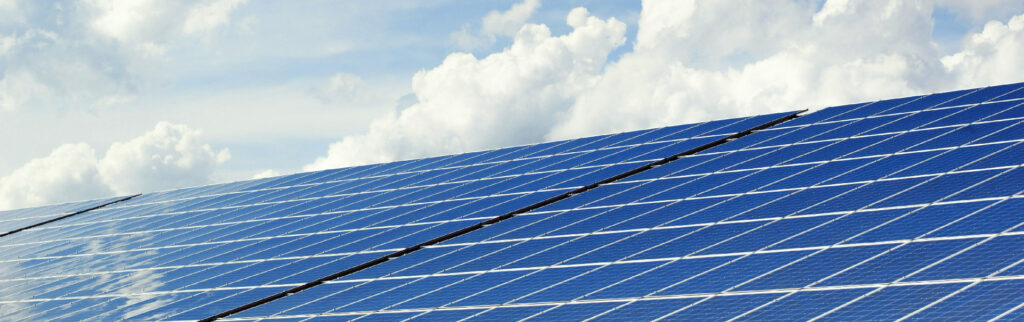
Photovoltaic Energy Storage
- Application Scenarios: Photovoltaic inverters (string type), energy storage converters, energy storage lithium batteries
- Power Levels: Photovoltaic inverters: ≤500kW; Energy storage inverters: 3–500kW; Lithium batteries: 48V
- Power Inductors: Boost inductors, BUCK-BOOST inductors, inverter inductors, grid-side inductors, PFC inductors (bidirectional/interleaved parallel), filter inductors (busbar), integrated resonant inductors (LLC/DAB)
- Related Magnetic Cores/Materials: GPV/GPC/NPC/NPV/NPH/NPF/NPG
- Typical Application Types: 5/20/30/50/100/125/150/200/215/250/300/350/400/500kW

Home Appliances
- Application Scenario: Home Inverter Air Conditioner
- Cooling Capacity: 1.5 HP (Household)
- Power Inductors: PFC inductor, output filter inductor, DC-DC converter inductor
- Switching Frequency: 28kHz/40kHz/56kHz/60kHz/70kHz
- Related Core/Material: NPH/NPC/GPC
- Core Models: 107-114-140-157-158-184-226-250…

Power Supply
Communication Power Supplies / Server Power Supplies
- Power rating: 60-150 kW
- Power inductors: PFC inductors, resonant inductors
- Related core materials: NPN/NPN-LH/GPN/GPC
Uninterruptible Power Supply (UPS)
- Power rating: 7.5-100kW
- Power inductors: Inverter inductor + PFC inductor + charging/discharging inductor + (balancing inductor)
- Related core/material: NPC/NPV/NPF/NPH
Active Power Filter (APF)
- Related core/material: NPF
LET US EARN YOUR BUSINESS
We invite you to partner with GMCore and experience the exceptional service and innovative solutions.